
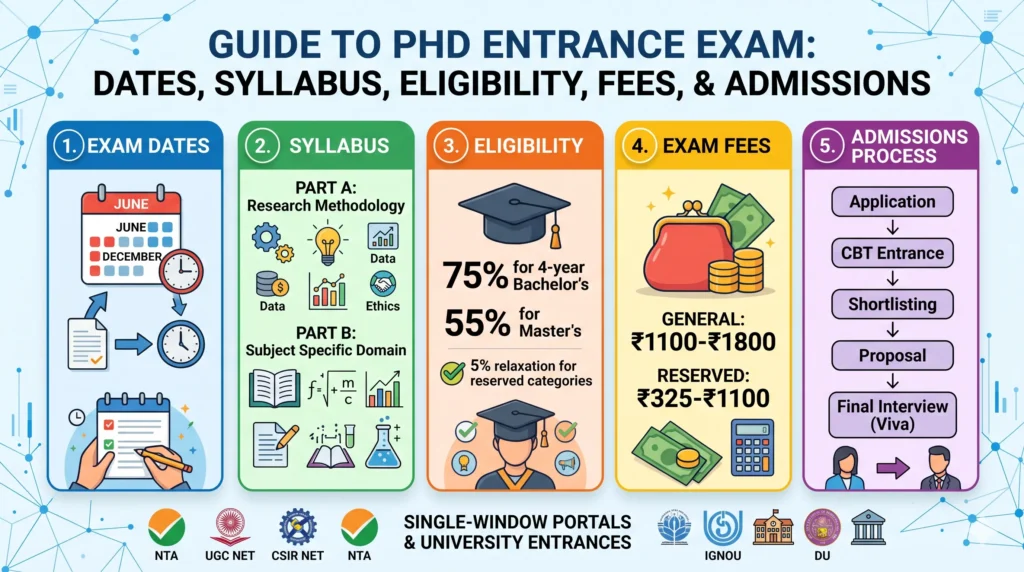
The PhD Entrance Exam 2026 scene has evolved dramatically, adopting sophisticated computer-based testing models, streamlined eligibility criteria in alignment with the National Education Policy (NEP), and unified registration processes. In 2026, the scenario is more layered than it used to be UGC NET, CSIR NET, CUET-PG, GATE and a long list of university specific tests all play a role and the rules on which one you actually need have changed under newer UGC regulations. If you want to crack a national level eligibility test or secure a seat through top university level tests, this complete guide has everything from application deadlines to syllabus breakdown for your PhD admission 2026 journey. , how the patterns differ, and how to prepare.
PhD Entrance Exam
The PhD Course 2026 Entrance Exam is a highly competitive, standardized screening process used by central, state, and premier private universities to evaluate an applicant’s readiness for a Doctor of Philosophy (PhD) degree. The PhD Entrance Exam is a standardized and highly competitive screening test that is used by the best central, state and private universities to determine the preparedness of an applicant for doctoral research.
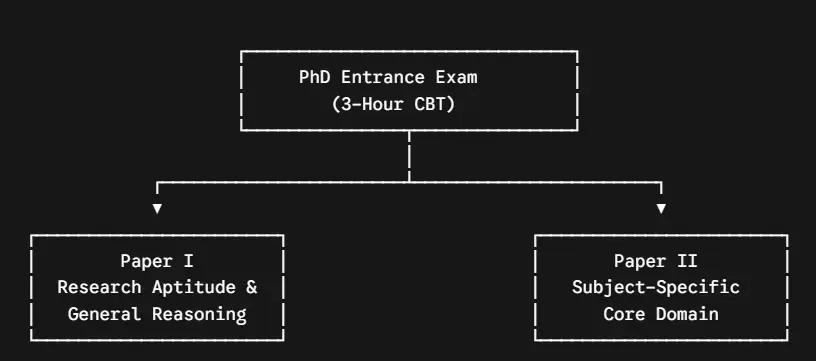
The exam generally includes a 3-hour computer-based test, where equal importance is given to Research Methodology (50%) and Subject-Specific domain knowledge (50%). As per the existing academic rules, final selection is made on a strict 70:30 merit formula where your written exam or national score (UGC NET, CSIR NET, GATE etc) carries 70% weightage and remaining 30% is based on viva-voce interview where you have to present and defend a structured research proposal before a faculty board.
| PhD University Admission 2026 | |
| Cotton University Phd Admission | Tezpur University PhD Admission |
National-Level PhD Entrance Exams in 2026
If you want to secure central funding or skip individual university-level tests, targeting a national-level eligibility test is your best path forward.
| 1. UGC NET (University Grants Commission National Eligibility Test)
Conducting Body: National Testing Agency (NTA) Best For: Humanities, Social Sciences, Commerce, Management, and Languages. 2026 Update: NTA conducts this entirely via Computer-Based Testing (CBT) across two shifts, covering over 80 elective subjects. |
| 2. CSIR NET (Council of Scientific and Industrial Research) Conducting Body: NTA / CSIR-HRDG Best For: Science and Engineering streams (Life Sciences, Chemical Sciences, Physical Sciences, Mathematical Sciences, and Earth Sciences). |
3. GATE (Graduate Aptitude Test in Engineering)
|
| 4. JEST (Joint Entrance Screening Test)
A specialised national test for PhD admission into physics and theoretical computer science programmes at premier research institutes (such as IUCAA, TIFR-affiliated centres, and IISERs). It’s frequently listed alongside GATE and NET as one of the standard routes into research institutions. JEST appears as one of the recognised PhD entrance exams in India alongside UGC NET, GPAT, CSIR NET, and GATE. |
| 5. ICAR AIEEA / AICE-JRF/SRF
For agricultural sciences PhDs, the ICAR conducts the All India Entrance Examination for Admission and the All India Competitive Examination for JRF/SRF, both administered by NTA. |
| 6. University-Specific Entrance Tests (RET-type exams)
Many universities run their own Research Entrance Test in addition to, or instead of, accepting national scores. As of 2026, 13 public universities — including Hyderabad, Calcutta, and BHU conduct their own entrance exams (RET or RET-style tests) for PhD admission, and NET-qualified candidates at institutions like JNU, IIMC, and University of Hyderabad get direct interview calls, cutting selection time by roughly 3–5 months compared to general applicants. |
| 3. CUET-PG (Common University Entrance Test for Postgraduate Programmes)
Run by the NTA, CUET-PG has become a key entry route into integrated and combined PG-PhD programmes at central universities. The exam is conducted entirely in Computer Based Test mode, with papers for M.Tech and higher sciences offered only in English, while humanities, sciences, and common subjects are bilingual (English and Hindi). Scores feed into admissions for the following academic session, and NTA’s role is limited to registering candidates, conducting the test, and declaring results — each participating university prepares its own merit list. |
8. Specialized Research Fellowships
|
PhD Entrance Exam Dates 2026
If you don’t register on time, you can be delayed a whole year in your PhD journey. A rough timeline for the main national and university level assessment cycles for the 2026 academic calendar is below:
| Entrance Examination | Application Registration Window | Tentative Exam Dates 2026 |
| GATE 2026 | September – October (Previous Year) | February 2026 |
| IGNOU PhD Entrance Exam 2026 | November – December | January 2026 / June 2026 (Bi-annual) |
| DU PhD Entrance Exam (Phase I & II) | Rolling (Phased windows across the year) | Tracked dynamically via department |
| UGC NET (June Session) | March – April 2026 | June 22 – June 30, 2026 |
| CSIR NET (Summer Cycle) | March – April 2026 | June 2026 |
Eligibility Criteria for PhD Admission 2026
Under the updated UGC regulations, eligibility is categorized strictly by your academic background. Take note of the 75% rule for undergraduate paths, which is a major update for the 2026 academic calendar.
Category-Wise Relaxations: A mandatory 5% relaxation (reducing requirements to 50% for Master’s holders and 70% for 4-year Bachelor’s graduates) is granted to SC, ST, OBC (Non-Creamy Layer), Differently-Abled, and EWS candidates.
| Qualification Level | Minimum Percentage Required | Special Conditions / Notes |
| Traditional Master’s Degree | 55% aggregate (or equivalent CGPA) | Must be in a relevant discipline from a recognized university. |
| 4-Year Bachelor’s Degree | 75% aggregate (or equivalent grade) | Must be an 8-semester “Honours with Research” program. |
| M.Phil. Holders | 55% aggregate | Only valid for candidates who completed it prior to its structural phase-out. |
PhD Entrance Exam Structure & Pattern
Most PhD entrance exams follow a structured, objective format divided into two distinct components. There is typically no negative marking in broad eligibility frameworks like the UGC NET, enabling candidates to attempt the full paper confidently.
- Paper I: Research Methodology & Aptitude (50% Weightage) Tests data interpretation, qualitative and quantitative reasoning, hypothesis testing, and standard research ethics.
- Paper II: Core Subject Knowledge (50% Weightage) Evaluates deep concept specialization in the chosen postgraduate field.
| Component | Typical Weightage/Format |
|---|---|
| General Aptitude / Research Methodology | Objective MCQs testing reasoning, statistics basics, and research ethics |
| Subject-Specific Paper | Core domain knowledge at master’s level |
| Negative Marking | Common (e.g., 25% in CSIR NET, varies by subject) |
| Mode | Predominantly Computer Based Test (CBT) |
| Final Selection | Written score + Interview/Viva-voce (commonly weighted around 70:30) |
Step-by-Step PhD Admission Process 2026
Navigating doctoral admissions involves a sequence of strict prerequisites. Messing up the order of operations—such as forgetting to draft a research proposal before university interviews begin—can result in structural delays
- Verify Eligibility & Exemptions
- Submit Online Applications
- Appear for the Entrance Exam
- Draft an Actionable Research Proposal
- Clear the Personal Interview (Viva-Voce)
IGNOU PhD Entrance Exam 2026
The Indira Gandhi National Open University (IGNOU) offers highly sought-after doctoral tracks across multiple streams.
- Exam Mode: 180-minute Computer-Based Test (CBT) composed completely of Multiple Choice Questions.
- Structure: Split exactly between 50% Research Methodology and 50% Subject-Specific testing.
- Exemption Policy: Candidates who have successfully cleared national assessments like UGC NET with JRF, CSIR NET, or hold a valid GATE score are heavily prioritized and frequently exempted from the written entrance exam, advancing straight to the personal interview.
- Selection Process: Passing the written exam requires a minimum of 50% marks (45% for reserved classes). Shortlisted individuals must defend an actionable research proposal before a formal faculty selection board.
DU PhD Entrance Exam 2026 (University of Delhi)
Admission to Delhi University (DU) is highly competitive and is typically executed across multiple phases within a single academic year to optimize seats.
- Portal Registration: All candidates must create an active profile via the dedicated DU PhD admission portal (phd.uod.ac.in) and pay the differential registration fee program-by-program.
- The Assessment Pipeline: DU relies directly on scores from the NTA-conducted UGC NET / CSIR NET examinations to shortlist applicants for its departments.
- Mandatory Research Proposal: Unlike general undergraduate applications, a fully formatted research proposal outlining your target research gap, objectives, and working methodology must be produced at the time of your evaluation.
- The Personal Interview (Viva-Voce): Shortlisted candidates must present an advanced technical topic before the Departmental Research Committee (DRC). Your selection hangs on a combined matrix evaluating your academic baseline, national test score, and presentation quality.
Expected PhD Entrance Exam 2026 Fees
Application processing charges fluctuate significantly depending on your targeted institution and reservation categories.
National-Level Average Fees
- General / Unreserved: ₹1,100 – ₹1,800
- OBC-NCL / EWS: ₹600 – ₹1,100
- SC / ST / PwD / Transgender: ₹325 – ₹600
University Portal Specific Fees
- IGNOU Application Fee: Uniformly priced at ₹1,000 for general applicants during standard online processing.
- Delhi University Registration Fee: Fixed at ₹750 per program for UR/OBC-NCL/EWS applicants, and ₹300 per program for SC/ST/PwBD candidates.
| Sreenarayanguru Open University Admission | |
| Allahabad University Distance Education | |
| Madras University Distance Education |
PhD Entrance Exam Syllabus Breakdown
Most doctoral exams employ a two-part objective assessment format designed to measure core aptitude alongside your specialized domain knowledge. The general framework consists of a 3-hour Computer-Based Test (CBT) divided equally:
| PhD Entrance Exam Syllabus 2026 | |
Part A: Research Methodology & Aptitude (50% Weightage)This section evaluates your foundational readiness for independent academic investigation. It remains common across almost all disciplines:
|
|
Part B: Subject-Specific Core Domain (50% Weightage)This section directly evaluates advanced conceptual clarity at the postgraduate level. The questions correspond exclusively to the specific elective discipline (e.g., English Literature, Organic Chemistry, Microeconomics, or Data Structures) chosen by the candidate. |
Quick Comparison Of Phd Entrance Exams
| Exam | Best For | Conducting Body |
|---|---|---|
| UGC NET | Humanities, Social Sciences, Commerce, Management | NTA (for UGC) |
| CSIR-UGC NET | Chemical, Life, Physical, Mathematical, Earth Sciences | NTA + CSIR |
| CUET-PG | Integrated/combined PG-PhD programmes, central universities | NTA |
| GATE | Engineering & Technology PhDs (IITs/NITs) | IITs (rotating) |
| JEST | Physics, Theoretical Computer Science (research institutes) | JEST Committee |
| ICAR AIEEA/AICE-JRF | Agricultural Sciences | NTA (for ICAR) |
| University RET | Discipline-specific, institution’s own programme | Individual universities |
Expected PhD Entrance Exam 2026 Fees
Application processing charges fluctuate significantly depending on your targeted institution and reservation categories.
National-Level Average Fees
- General / Unreserved: ₹1,100 – ₹1,800
- OBC-NCL / EWS: ₹600 – ₹1,100
- SC / ST / PwD / Transgender: ₹325 – ₹600
University Portal Specific Fees
- IGNOU Application Fee: Uniformly priced at ₹1,000 for general applicants during standard online processing.
- Delhi University Registration Fee: Fixed at ₹750 per program for UR/OBC-NCL/EWS applicants, and ₹300 per program for SC/ST/PwBD candidates.
Preparation Tips for PhD Entrance Exams 2026
- Start with the official syllabus, not coaching material. Syllabus and exam patterns are revised almost every cycle (CSIR NET’s 2026 notification, for instance, reconfirmed the three-part structure with subject-specific negative marking) — always cross-check against the current official notification.
- Build a strong base in research methodology. Regardless of subject, nearly every exam tests reasoning, basic statistics, and academic ethics — these are high-yield, low-volume topics worth mastering early.
- Practice previous years’ papers under timed conditions. Most national PhD-track exams (CSIR NET, UGC NET, CUET-PG) are pure CBT with negative marking, so accuracy under time pressure matters as much as raw subject knowledge.
- Track application windows closely. Correction windows are typically open for only 1–2 days right after the application deadline — missing them can lock in errors in your form.
- Decide your route early: NET vs CUET-PG vs university test. Since universities now have the freedom to choose which score they accept for PhD admission, check your target university’s specific policy before committing your preparation time to one exam.
- Don’t ignore the interview stage. With written-to-interview weightages often around 70:30, a strong research proposal and clear articulation of your research interest can meaningfully offset a middling written score.
- If you’re a final-year master’s student, plan your Result-Awaited (RA) category timeline carefully — most exams give only 1–2 years post-result to complete your qualifying degree before disqualification.
| Important Posts | |
| Online BA | |
| Online MCA | |
| Online MCom | |
| Online MA | |
| Online BCA | |
| Online BCom | |
| Online MBA in Business Analytics | |
Frequently Ask Questions
Q1: Which entrance exam is required for PhD admission in India?
Ans: To pursue a PhD in India, candidates primarily appear for major national-level eligibility tests like the UGC NET (for Humanities, Management, and Social Sciences), CSIR NET (for Science streams), or GATE (for Engineering and Technology). Additionally, several premier institutions conduct their own individual university-based entrance exams or accept scores from common university entrance platforms.
Q2: Is NET compulsory for PhD admission?
Ans: Under recent regulatory updates, the University Grants Commission has established UGC NET scores as a centralized channel for doctoral enrollment across most Indian universities. While it is heavily prioritized and can exempt you from written university-level screening tests, some alternative local university tests or international/online doctorate formats may maintain independent criteria.
Q3: What are the major upcoming PhD entrance exams?
Ans: The prominent testing cycles include the bi-annual UGC NET and CSIR NET sessions (traditionally held around June/July and December), the engineering-centric GATE exam, alongside specialized central university notifications released periodically throughout the academic term.
Q4: Is there a unified CUET PhD entrance exam?
Ans: While CUET heavily regulates undergraduate (UG) and postgraduate (PG) centralized processing, doctoral admissions depend strictly on the UGC NET/CSIR NET frameworks or distinct institutional web windows rather than a standard single multi-tier CUET PhD structure.
Q5: How can I apply for the Delhi University (DU) PhD entrance exam?
Ans: Admission to the University of Delhi requires candidates to track phase-wise registration windows via the specialized DU portal (admission.uod.ac.in). DU accepts UGC NET, CSIR NET, and JRF scores to shortlist eligible research candidates for departmental interview panels.
Q6: What is the baseline process for the IGNOU PhD entrance exam?
Ans: The Indira Gandhi National Open University (IGNOU) invites applications for various doctoral streams during its active academic cycles. The evaluation traditionally gauges structural performance split between research methodology and domain elective knowledge, with exemptions available for valid national fellowship holders.
Q7: Are there separate application tracks for government universities?
Ans: Yes. Government universities frequently process PhD intakes using a multi-phase system. Candidates qualifying for national exams (NET/JRF) must register directly on the government university’s personal portal during active filing windows to be evaluated for final seat allotment.
Q8: Where can I check the application form last date for UGC NET?
Ans: The application registration and window adjustments are managed directly on the official National Testing Agency (NTA) portals. Missing these dates prevents enrollment for that active testing cycle.
Q9: What is the general structure of a PhD entrance exam?
Ans: Most standard doctoral tests employ a 3-hour objective assessment platform broken into two core segments: Part A (Research Methodology & Aptitude), which tests analytical logic and ethics, and Part B (Subject-Specific Core), which evaluates postgraduate concept mastery.
Q10: What are the typical application fees for university PhD registrations?
Ans: While fee parameters fluctuate, major central institutions like Delhi University define tiered brackets: typically around ₹750 per program for unreserved categories (UR, EWS, OBC-NCL) and a relaxed tier of ₹300 per program for SC, ST, and PwBD research applicants.
